Showing posts with label Strikes. Show all posts

Tuesday, 27 January 2015

Advert - NUR Ballot (1972)

Click to Enlarge

The 1970's have become synonymous with industrial unrest and this 1972 National Union of Railwaymen advert is a reminder.

Sunday, 17 November 2013

The Crowning of George VI

Daily Mirror dated Thursday May 13th 1937
Click to Read
Click to Read
Click to Read
The King who shouldn’t have been. May 12th 1937 was to have been the Coronation of Edward VIII but when George V eldest son chose marriage, to the divorcee Wallis Simpson, over the Crown, the succession passed to the second son - Albert, Duke of York. He became a surprisingly successful and popular King but ill health cut his reign short in 1952. 

Click to Read
A possible question for ‘QI’ – how many Queen Elizabeth’s have we had? Allen Davis senses a trap and refuses to answer.
First time contestant Ami Childs buzzes in, “There was, like, Queen Elizabeth but that was, like, ages ago, you know, like Shakespeare and all that.”
Ross Noble bites the bullet. “Two”
Klaxon sounds.
Stephen Fry looks smug. “No. At least 3 and by some accounts 5. Queen Elizabeth 1 and 2 and GeorgeVI’s wife Elizabeth. Edward VI and Henry VII were also married to Elizabeths.”  

Click to Read
Being of the peerage doesn’t make you immune to life’s troubles. Gustavus’ wife Joan died the following year and he was killed in action in France in 1940. The surviving son Gustavus Michael became the 10th Viscount Boyne.

Click to Read
£4000 is the equivalent of about £150,000 now. I thought the ‘take no responsibility for your actions and sue’ culture was something new.

Click to Read
This 4 week long strike was protesting about conditions of work for London bus drivers and conductors, notably hours of work, rates of pay and a proposed speed-up of London buses. Failure to involve the Underground and Tram workers was blamed for the failure of the strike.

Click to Read
Maureen O’Sullivan shot to fame as a very scantily clad Jane to Johnny Weissmuller’s Tarzan in ‘Tarzan the Ape Man’ in 1932. She went on to appear in another 50 or more films and to do a lot of TV work over the next 62 years. She died in 1998. 

Click to Read
King Alfonso XIII left Spain in 1931 after the country had been proclaimed a Republic and his eldest son, also Alfonso, took the title Count of Covadonga.
In May 1937 the ex-King Alfonso severed relations with the Count, blaming him for making public assertions that he still considered himself legitimate heir to the Spanish Crown.
He married Marta Rocafort-Altuzarra in July 1937 but they were divorced in January 1938.
In September 1938 the Count was being driven home from a party in Miami when the car crashed. He died six hours later.

Click to Read
Popeye had first appeared as a character in the American syndicated newspaper strip ‘Thimble Theatre’ in 1929 and this is his introduction to the UK newspaper print, although he had been seen over here in cartoon films.

Click to Read
They certainly took their comic strips seriously in the 1930’s, and with the quality of ‘Jane’, ‘The Ruggles’, ‘Belinda Blue Eyes’, ‘Buck Ryan’ and ‘Gordon Fyfe’ I’m not surprised.

Click to Read
For ‘candid camera pests' read ‘paparazzi’. New York Mayor Fiorello H. La Guardia was re-elected and in fact held that office from 1934 until December 1945. William Griffin was all for keeping the US out of World War II and narrowly missed being put on trial for subversion in 1942.

Click to Read
One definition of ‘to croon’ is ‘to sing popular songs in a soft, sentimental manner’. So a crooner is someone, usually a man, who croons. With the advent of the microphone it was no longer necessary from a singer to sing loudly or project his voice to be heard at the back of a theatre, so a quieter more intimate style of popular singing developed as epitomised by Bing Crosby, Rudy Vallie and Frank Sinatra.

Sunday, 3 November 2013

Old Bailey and Whitehall IRA bombings

Daily Mirror dated Friday March 9th 1973
Click to read
Click to read
Click to read
In the first IRA mainland bombings since 1940, four car bombs were planted in London on March 8th. Two were defused, one in a car outside a Post Office in Broadway and the other outside the BBC's armed forces radio studio in Dean Stanley Street. However, the other two exploded, one near the Old Bailey and the other at the Ministry of Agriculture off Whitehall. As a result of the explosions one person was killed and almost 200 people were injured.

At the time I worked near the Old Bailey at the top of Ludgate Hill, directly opposite St Paul’s Cathedral. I had a habit of popping out mid-afternoon to buy a Mars bar and was crossing the old Paternoster piazza when there was a very loud boom that I felt as much as heard. As the crow flies I was only about 300m from the blast. Luckily there were a lot of buildings in the way.

Click to read
Click to read
The people arrested at Heathrow included Marian and Dolours Price, Gerry Kelly, Hugh Feeney and Roisin McNearney. In November 1973 all except McNearney, who had turned Queen’s evidence, were convicted of the Old Bailey and Whitehall bombings. 

Click to read
Rail chaos, miners' strikes, dock strikes, go-slows, walk outs - this was the hay-day of the militant unions, but they had no way of knowing that Margaret Thatcher’s reign was only 6 years away (give or take 4 or 5 days).

Click to read
The London School of Economics had been a hot-bed of student unrest since 1966 and this was yet another in a series of protests. 

Click to read
On March 5th sixty-eight people had been killed when a Douglas DC-9, flying from Palma to London, collided in midair with a Convair 990 Coronado aircraft over Nantes in western France. The accident occurred during a French air traffic controller’s strike and stand-in military controllers were being used.

Click to read
The problem is whether to watch ‘The Virginian’ and then ‘Morcambe and Wise’ or ‘Hawaii Five-O’ and ‘On the Buses’? There’d be no hesitation in watching one of my favourite films though – Jean Luc Goddard’s ‘Alphaville’.

Click to read
Straight forward story – fan sends Paul McCartney seeds, he plants them, they come up as cannabis, police see them, he appears in court and is fined. I think there is a printing error though. McCartney is quoted as saying ‘there should be legislation on the use of cannabis’. Surely there was or he wouldn’t be in court.

Click to read
Fans got more than they bargained for when, in 2002, the iconic Wembley Stadium was demolished and a new stadium built on the site.

Sunday, 6 October 2013

Labour’s Most Critical Week

The Pall Mall Gazette dated Monday February 21st 1919
Click to Read
The Pall Mall Gazette was founded as a pro-conservative evening paper in 1865 and lasted until it merged with the Evening Standard in 1923.
The War may be over but the Versailles Peace Treaty is still being forged, labour unrest in Britain increases and Germany is politically and economically unstable.

Click to Read
(Cont’d from page 1)
All this talk of Germany paying for pensions etc was changed when the total amount of reparations was fixed in 1921 on the basis of the German capacity to pay, not on the basis of Allied claims. The debt was set at about £1billion and by 1931 they had repaid less that 20% when the debt was suspended indefinitely, although it was revived in 1953 and paid off in full by West Germany.

Click to Read
(Cont’d from page 1)
Demobbed soldiers found a very different Britain to the one they left in 1914. High unemployment, a rising cost of living, strikes by newly organised unions and a severe shortage of houses were the order of the day.

Click to Read
As George Clemenceau, the French Prime Minister and President of the Paris Peace Conference, was leaving his house the previous Thursday, a man fired several shots at his car. Clemenceau was hit once between the ribs, just missing his vital organs. His attacker, Emile Cottin, was seized by the crowd and nearly lynched. Clemenceau died in 1929 with the bullet still in him.

Click to Read
The Pall Mall Gazette, being an evening paper, is commenting here on the news that Kurt Eisner the Socialist who had declared Bavaria an independent state, had been assassinated in Berlin earlier in the day. Immediately following The Great War Germany was in turmoil with various factions for or against the terms of the surrender and the occupation of the industrial Ruhr by the French. Bavaria was strongly anti-French and became the breeding ground for Nazism as the 1920’s progressed.

Click to Read
The Late News tells us that Prince Leopold of Bavaria had been arrested on suspicion of being involved in the plot to murder Eisner. 

Click to Read
No great mystery really – the retired actress Jessie Francis, wife of actor/manager Frederick Wright Sr. and mother of comedians Huntley and Fred Wright, died of a heart attack during or after a burglary. 

Click to Read
The Melville Brothers (Walter and Frederick) owned and managed theatres, including the Lyceum in London, as well as writing and directing plays like this melodrama of German spies that ends with a British General shooting his traitorous wife, the Female Hun of the title.

Click to Read
Special constables as we know them now date back to the First World War. The case of Herbert Stanton Moss can’t have helped the distrust the public had for the Specials as reflected in the lyrics of the popular 1919 song ‘My Old Man (Said Follow the Van)’ – ‘…you can’t trust a Special like an old-time copper…’

Click to Read
There are no photos in the Pall Mall Gazette so this fashion drawing is a nice relief from the pages of text.

Click to Read
With the benefit of hindsight, it is obvious that Prohibition in the USA between 1919 and 1933 did not work and even had a detrimental effect on society with the criminalisation of social drinking and the rise in organized crime to support the supply of alcoholic drinks. This article is referring not to the 18th Amendment and the Volstead Act that brought in National Prohibition on January 1st 1920, but to the temporary Wartime Prohibition Act that preceded it.

Click to Read
I wonder if Lt.-Col PSC was at all mollified by the 1920 issue of the Bronze Oak Leaf to all service personnel mentioned in despatches. I doubt it.

Sunday, 21 July 2013

Valentino admirer's suicide

Evening Standard dated Thursday August 26th 1926
Click to read
Rudolph Valentino had died the previous Monday. See this post. Peggy Scott was variously described as an actress, dancer and scriptwriter but I can’t find anything online about her career. She had claimed to know Valentino but a representative of the late star attended Scott’s inquest and denied any connection between the two.

Click to read
Cont'd from page 1
After the General Strike of May 1926 the coalminers were no better off than before and continued their strike. By November it had fizzled out as workers at mine after mine were forced back to work as their Unions ran out of money. The tone of this article, especially the last ‘Down the Pit’ section is decidedly anti-miners and this may well reflect the opinion of the paper’s owner Lord Beaverbrook.

Click to read
Valentino’s body was laid out for public viewing in the Gold Room of Frank E Campbell’s Funeral Church in Manhattan, where others including Oscar Hammerstein and Enrico Caruso had also been displayed. The circus atmosphere that surrounded the lying-in-state, encouraged by the media presence, offended George Ullman and he stopped it after only 2 days. It turned out that the Fascist guards mentioned in the article were in fact a publicity stunt concocted by the Funeral Home’s management and that the wreath from Mussolini was bought in the Home’s own florists.

Click to read
Edward Creed had been the manager of a cheese shop and on the night of July 28th his assistant left him to put the day’s taking in the safe and to lock up the shop. Several hours later the next-door neighbour thought he could smell gas coming from the shop and he called the police. They found Mr Creed dead and the gas jets on but unlit. The safe had been cleared of money. Witnesses placed 2 men loitering near the shop on the day of the murder and the police published descriptions but no one was found. The two women mentioned in the article were never traced and a verdict of ‘murder by person or persons unknown’ was returned at the inquest. The case remains unsolved.

Click to read
Krishna Murti (or Jiddu Krishnamurti) was born in 1895 in India and at the age of 14 was taken under the wing of Charles Webster Leadbeater and Theosophical Society who groomed him to be the new World Teacher. After training and a European education he travelled the World lecturing on esotericism, or hidden knowledge or wisdom that offers the individual enlightenment and salvation. In 1929 he split from the Theosophical Society, but continued teaching until his death in 1986.

Click to read
Presumably Sarah Carlisle was under 21, because I believe that Thomas H Grater was 24, having been born, according to the FreeBMD website, in 1902, and if they had both been over 21 they wouldn’t have needed any parent’s permission. A further search at FreeBMD shows Thomas marrying in 1930 to a lady by the name of Broughton. Sarah Carlisle is too common a name to pin her down.

Click to read
I remember hearing these SOS messages at the end of news broadcasts and usually of the form ‘would so-and-so believed to be on holiday in the Lake District please contact their mother who is seriously ill’. They became redundant with the spread of mobile phones in 1990’s. 

Click to read
Yes you guessed it – it’s the drawing that made me post this, although a cold Barclay’s Lager would go down a treat today. It was brewed by Barclay Perkins of Southwark, not by a bunch of merchant bankers.

Click to read
The term ‘bandit’ seems to refer specifically to motorised smash and grab raiders. According to Robert Murphy’s very good book ‘Smash and Grab – Gangsters in the London Underworld’ the most famous girl bandit was Lilian Goldstein who drove for Ruby Sparks while they carried out numerous raids between 1922 and 1927.

Click to read
Quite what this fashionable young lady is doing with a coal-scuttle on her head is anyone’s guess, but then I know nothing about haute couture.

Click to read
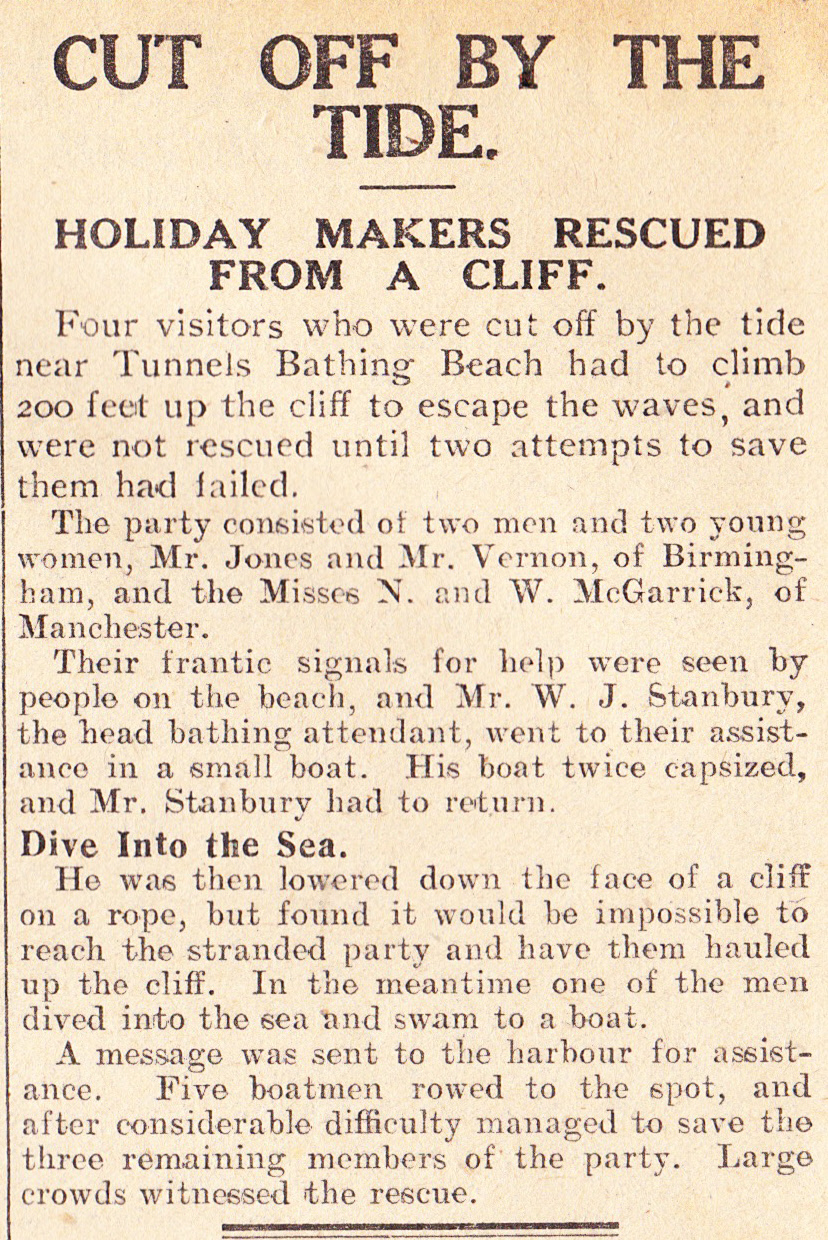
Tunnels Bathing Beach was, and still is, a feature of Ilfracombe, North Devon. No helicopter rescues in those days. 

Click to read
I remember that when I was a kid it was common knowledge that stevedores at the London Docks, while unloading bananas from ships, were forever being attacked by tarantulas. There again it was common knowledge that if you trod on the cracks in the pavement the boogieman would get you.

Click to read
The famous songwriter Irving Berlin was a Russian-Jewish immigrant and Ellin Mackay was a Catholic heiress and daughter of the head of the Postal Telegraph Cable Company. Despite Mr Mackay’s objections, the couple were married at the New York City Hall on January 4th 1926 and he subsequently wrote her out of his will. It took another 5 years for father and daughter to be reconciled.

Click to read
Nicholas Zographos was one fifth of the infamous ‘Greek Syndicate’ of gamblers who were a fixture of the great European casinos of the inter-War period. A detailed article on the Syndicate can be found here. Zographos died in 1953.

Click to read
An example of the art being created for the London Underground in the 1920’s. Charles Paine, whose name adorns this advert, produced posters and advertising artwork for the LU from 1920 until 1929. He was born in 1895 and died in 1967.