Showing posts with label Fashion. Show all posts

Friday, 24 April 2015

Advert - Gamages Store (1950's)

Click to Enlarge

1950's Gamage Store. I worked opposite it in the 1960's and spent many a lunch-hour exploring its nooks and crannies. Typical that an advert for business suits would also include archery bows - they stocked everything.

Friday, 6 March 2015

Advert - Garrould's Red Cross etc supplies (WWI)


A WWI advert for Garrould's of Edgware Road. For 'the seat of War' read 'up to your ears in mud and bullets'.

Wednesday, 4 February 2015

Cutting - Paris Fashion (1923)

March 1923
Click to Read

I must admit I don't understand fashion, so I give you, without comment, three examples of Paris fashion from March 1923. 
The mentioning of 'Egyptian' was sign of the time. Following Howard Carter's discovery of the tomb of Tutankhamun and his opening of the burial chamber in February 1923 everything had to have an Egyptian connection.

Friday, 16 January 2015

Advert - Whiteley's Furs (approx 1910)

Click to Enlarge

Whiteley's furs. Those were the days when wearing a dead wolf, bear or hare round your neck was a la mode. I note that the wolf was 'cross'. I assume the strong frames on the Whiteley umbrellas were for when you were clubbing seals to death.

Friday, 26 December 2014

Advert - Barratt Shoes (1926)

Click to Enlarge

Founded in Northampton in 1903 Barratt Shoes were a successful country wide chain by the 1920's. Who needs x-ray machines or special gauges to get the right size shoe when you have a pencil and a bit of paper handy?

Sunday, 1 December 2013

England scores 280 first innings

Sunday Pictorial dated Sunday August 15th 1926
Click to Read
Click to Read
Click to Read
I must admit that on reading this headline ‘England scores 280 first innings’ I had no idea whether it was a ‘Hooray for England’ or a ‘England team let us down again’ headline. I don’t understand cricket scoring.
A look on this web page told me England won the 5th Test in 1926 by 289 runs.
Ask me in 5 minutes who won and by how many runs and I will have forgotten, but I am sure there are people out there that will find these pages interesting. 

Click to Read
Click to Read
The death of John Thomas Derham resulted from a fight with his friend Alphonso (or Alphonse) Smith over Smith’s wife Catherine.
Smith was found not guilty of murder or manslaughter in November 1926 but sentenced to 12 months for possession of a firearm with intent to injure. The comparatively lenient sentence was passed because the judge believed that Smith only intended to kill himself.

Click to Read
In fact the Reverend John Alexander Smith died of his head wound the next day. 

 Click to Read
Click to Read
At least this fire in a paint factory in Southwark ended without loss of life and even three cats were saved.

Click to Read
In June 1916 Lord Kitchener sailed on the battle cruiser HMS Hampshire for a diplomatic mission to Russia, but the ship struck a mine laid by U-boat U-75 and sank. Kitchener, his staff, and 643 of the crew of 655 were drowned or died of exposure. His body was never found.
In 1926, a hoaxer, Frank Power, claimed that a Norwegian fisherman had found Kitchener’s body. Power brought a coffin back from Norway and prepared it for burial in St. Paul's. At this point, however, the authorities intervened and the coffin was opened in the presence of police and a distinguished pathologist. The box was found to contain only tar for weight. Power was never prosecuted.

Click to Read
I have a funny feeling that whoever tried to fill this in didn’t stand an chance of winning that rather nice Bullnose Morris Cowley, and should have sent off for the 64 page booklet on how to complete crosswords. Rather an odd feature of this grid is the use of clues marked ‘actual’ so R.T.B. (actual) is literally RTB. The other oddity I’ve noticed is 20 across and 20 down is the same isolated square with a ‘D’ pre-printed.
The first crossword to appear in a UK newspaper was only 2 years previously in 1924.

Click to Read
Arthur Ferrier was born and started working as a cartoonist in Glasgow, then he moved to London and drew joke cartoons for newspapers and  magazines.
In 1930 he created Britain’s first ‘glamour’ cartoon strip called ‘Film Fanny’. The most famous ‘glamour’ strip was the Daily Mirror’s ‘Jane’. The Sunday Pictorial also published his ‘Our Dumb Blonde’ strip, which ran from 1939 to 1946, followed by ‘Spotlight on Sally’ and ‘Eve’.

Click to Read
“By Gad, Sir! Whatever next? They’ll be teaching the little blighters to use the Interweb, what ever that it. A damn good thrashing would do them a sight more good. Pass the cane!”

Click to Read
Only 13 years before World War II and, apart from talk of getting rid of horses, this could be from World War I.

Click to Read
Probably the Bristol Bulldog single seater biplane fighter introduced into service in 1927.
The racing seaplane mentioned here is the Gloster VI, which was entered for the 1929 Schneider Trophy race, but was beaten by the Supermarine S6. 

Click to Read
Ah, the old ‘daring-short-skirt-flat-chested-coal-scuttle for a hat’ look. Although the one on the right has gone for the mis-tossed pancake hat. Nice drawings though by Renee Maude.

Sunday, 6 October 2013

Labour’s Most Critical Week

The Pall Mall Gazette dated Monday February 21st 1919
Click to Read
The Pall Mall Gazette was founded as a pro-conservative evening paper in 1865 and lasted until it merged with the Evening Standard in 1923.
The War may be over but the Versailles Peace Treaty is still being forged, labour unrest in Britain increases and Germany is politically and economically unstable.

Click to Read
(Cont’d from page 1)
All this talk of Germany paying for pensions etc was changed when the total amount of reparations was fixed in 1921 on the basis of the German capacity to pay, not on the basis of Allied claims. The debt was set at about £1billion and by 1931 they had repaid less that 20% when the debt was suspended indefinitely, although it was revived in 1953 and paid off in full by West Germany.

Click to Read
(Cont’d from page 1)
Demobbed soldiers found a very different Britain to the one they left in 1914. High unemployment, a rising cost of living, strikes by newly organised unions and a severe shortage of houses were the order of the day.

Click to Read
As George Clemenceau, the French Prime Minister and President of the Paris Peace Conference, was leaving his house the previous Thursday, a man fired several shots at his car. Clemenceau was hit once between the ribs, just missing his vital organs. His attacker, Emile Cottin, was seized by the crowd and nearly lynched. Clemenceau died in 1929 with the bullet still in him.

Click to Read
The Pall Mall Gazette, being an evening paper, is commenting here on the news that Kurt Eisner the Socialist who had declared Bavaria an independent state, had been assassinated in Berlin earlier in the day. Immediately following The Great War Germany was in turmoil with various factions for or against the terms of the surrender and the occupation of the industrial Ruhr by the French. Bavaria was strongly anti-French and became the breeding ground for Nazism as the 1920’s progressed.

Click to Read
The Late News tells us that Prince Leopold of Bavaria had been arrested on suspicion of being involved in the plot to murder Eisner. 

Click to Read
No great mystery really – the retired actress Jessie Francis, wife of actor/manager Frederick Wright Sr. and mother of comedians Huntley and Fred Wright, died of a heart attack during or after a burglary. 

Click to Read
The Melville Brothers (Walter and Frederick) owned and managed theatres, including the Lyceum in London, as well as writing and directing plays like this melodrama of German spies that ends with a British General shooting his traitorous wife, the Female Hun of the title.

Click to Read
Special constables as we know them now date back to the First World War. The case of Herbert Stanton Moss can’t have helped the distrust the public had for the Specials as reflected in the lyrics of the popular 1919 song ‘My Old Man (Said Follow the Van)’ – ‘…you can’t trust a Special like an old-time copper…’

Click to Read
There are no photos in the Pall Mall Gazette so this fashion drawing is a nice relief from the pages of text.

Click to Read
With the benefit of hindsight, it is obvious that Prohibition in the USA between 1919 and 1933 did not work and even had a detrimental effect on society with the criminalisation of social drinking and the rise in organized crime to support the supply of alcoholic drinks. This article is referring not to the 18th Amendment and the Volstead Act that brought in National Prohibition on January 1st 1920, but to the temporary Wartime Prohibition Act that preceded it.

Click to Read
I wonder if Lt.-Col PSC was at all mollified by the 1920 issue of the Bronze Oak Leaf to all service personnel mentioned in despatches. I doubt it.

Wednesday, 7 August 2013

Random Cutting - Daily Mirror Beauty Contest (1926)

.
Click to Read
6 hopefuls in the Daily Mirror Beauty Contest of 1926. I've no idea who won but it did remind me to play my copy of Blind Alfred Reed's song 'Why Do You Bob Your Hair, Girls?' released in 1927.

Sunday, 21 July 2013

Valentino admirer's suicide

Evening Standard dated Thursday August 26th 1926
Click to read
Rudolph Valentino had died the previous Monday. See this post. Peggy Scott was variously described as an actress, dancer and scriptwriter but I can’t find anything online about her career. She had claimed to know Valentino but a representative of the late star attended Scott’s inquest and denied any connection between the two.

Click to read
Cont'd from page 1
After the General Strike of May 1926 the coalminers were no better off than before and continued their strike. By November it had fizzled out as workers at mine after mine were forced back to work as their Unions ran out of money. The tone of this article, especially the last ‘Down the Pit’ section is decidedly anti-miners and this may well reflect the opinion of the paper’s owner Lord Beaverbrook.

Click to read
Valentino’s body was laid out for public viewing in the Gold Room of Frank E Campbell’s Funeral Church in Manhattan, where others including Oscar Hammerstein and Enrico Caruso had also been displayed. The circus atmosphere that surrounded the lying-in-state, encouraged by the media presence, offended George Ullman and he stopped it after only 2 days. It turned out that the Fascist guards mentioned in the article were in fact a publicity stunt concocted by the Funeral Home’s management and that the wreath from Mussolini was bought in the Home’s own florists.

Click to read
Edward Creed had been the manager of a cheese shop and on the night of July 28th his assistant left him to put the day’s taking in the safe and to lock up the shop. Several hours later the next-door neighbour thought he could smell gas coming from the shop and he called the police. They found Mr Creed dead and the gas jets on but unlit. The safe had been cleared of money. Witnesses placed 2 men loitering near the shop on the day of the murder and the police published descriptions but no one was found. The two women mentioned in the article were never traced and a verdict of ‘murder by person or persons unknown’ was returned at the inquest. The case remains unsolved.

Click to read
Krishna Murti (or Jiddu Krishnamurti) was born in 1895 in India and at the age of 14 was taken under the wing of Charles Webster Leadbeater and Theosophical Society who groomed him to be the new World Teacher. After training and a European education he travelled the World lecturing on esotericism, or hidden knowledge or wisdom that offers the individual enlightenment and salvation. In 1929 he split from the Theosophical Society, but continued teaching until his death in 1986.

Click to read
Presumably Sarah Carlisle was under 21, because I believe that Thomas H Grater was 24, having been born, according to the FreeBMD website, in 1902, and if they had both been over 21 they wouldn’t have needed any parent’s permission. A further search at FreeBMD shows Thomas marrying in 1930 to a lady by the name of Broughton. Sarah Carlisle is too common a name to pin her down.

Click to read
I remember hearing these SOS messages at the end of news broadcasts and usually of the form ‘would so-and-so believed to be on holiday in the Lake District please contact their mother who is seriously ill’. They became redundant with the spread of mobile phones in 1990’s. 

Click to read
Yes you guessed it – it’s the drawing that made me post this, although a cold Barclay’s Lager would go down a treat today. It was brewed by Barclay Perkins of Southwark, not by a bunch of merchant bankers.

Click to read
The term ‘bandit’ seems to refer specifically to motorised smash and grab raiders. According to Robert Murphy’s very good book ‘Smash and Grab – Gangsters in the London Underworld’ the most famous girl bandit was Lilian Goldstein who drove for Ruby Sparks while they carried out numerous raids between 1922 and 1927.

Click to read
Quite what this fashionable young lady is doing with a coal-scuttle on her head is anyone’s guess, but then I know nothing about haute couture.

Click to read
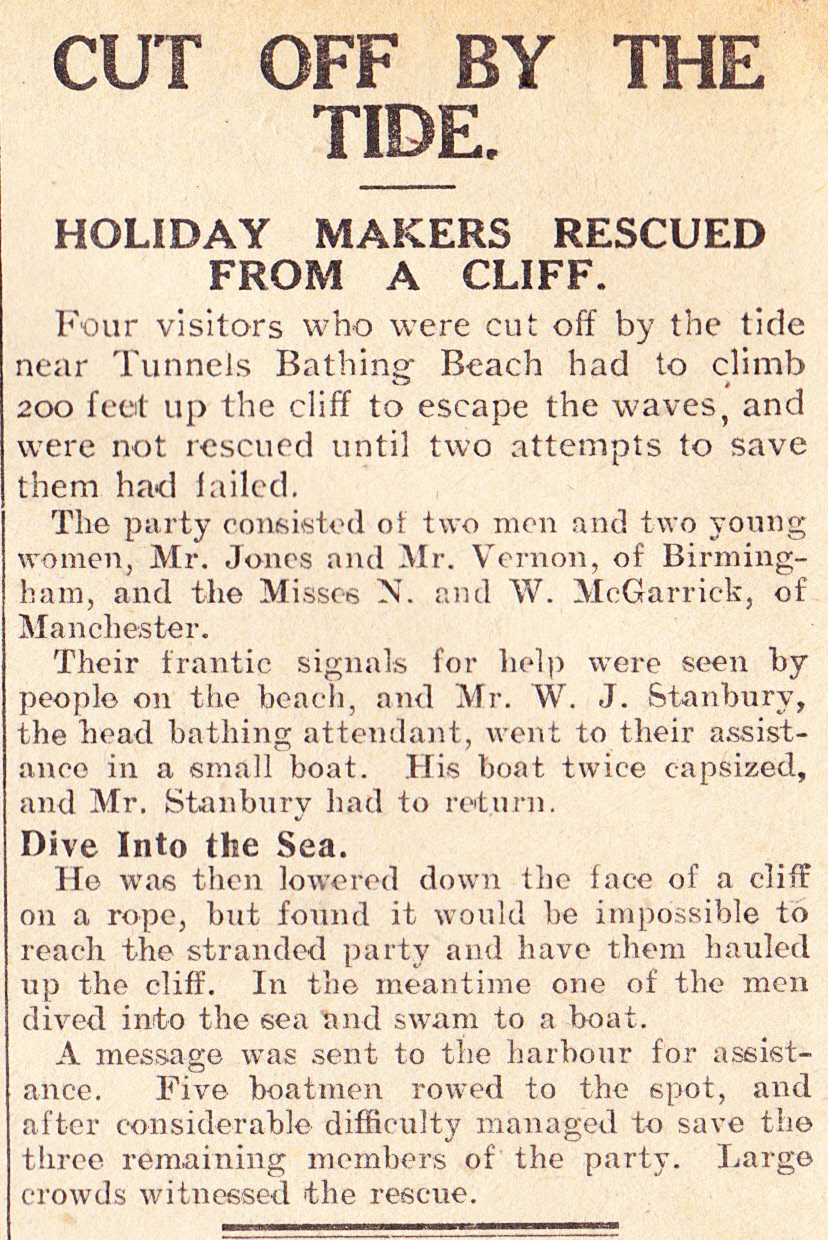
Tunnels Bathing Beach was, and still is, a feature of Ilfracombe, North Devon. No helicopter rescues in those days. 

Click to read
I remember that when I was a kid it was common knowledge that stevedores at the London Docks, while unloading bananas from ships, were forever being attacked by tarantulas. There again it was common knowledge that if you trod on the cracks in the pavement the boogieman would get you.

Click to read
The famous songwriter Irving Berlin was a Russian-Jewish immigrant and Ellin Mackay was a Catholic heiress and daughter of the head of the Postal Telegraph Cable Company. Despite Mr Mackay’s objections, the couple were married at the New York City Hall on January 4th 1926 and he subsequently wrote her out of his will. It took another 5 years for father and daughter to be reconciled.

Click to read
Nicholas Zographos was one fifth of the infamous ‘Greek Syndicate’ of gamblers who were a fixture of the great European casinos of the inter-War period. A detailed article on the Syndicate can be found here. Zographos died in 1953.

Click to read
An example of the art being created for the London Underground in the 1920’s. Charles Paine, whose name adorns this advert, produced posters and advertising artwork for the LU from 1920 until 1929. He was born in 1895 and died in 1967.

Friday, 21 June 2013

Random Ad - Brylcreem (1950's)

Click to Enlarge
It wouldn't be the 1950's with Brylcreem - playboy, businessman or Teddy Boy you had to have your hair glued in place with smooth, white and non-sticky Brylcreem. You can add Canadian film and TV actor to that list. Robert Beatty (for it is he) is probably best remembered, by those of a certain age, for the London based TV cop drama 'Dial 999'

Friday, 31 May 2013

Random Ad - Mailgear (1974)

Click to Enlarge
Unfortunately an eager letter to Mailgear will no longer get you a stylish plastic, sorry PVC jacket and blonde lady looking up your right nostril. Note the lack of a web address, it was snail-mail all the way in those days. Try Google'ing Mailgear now and it seems to be all about something called online war-gaming, which the guy in the photo looks to me like an enthusiast.